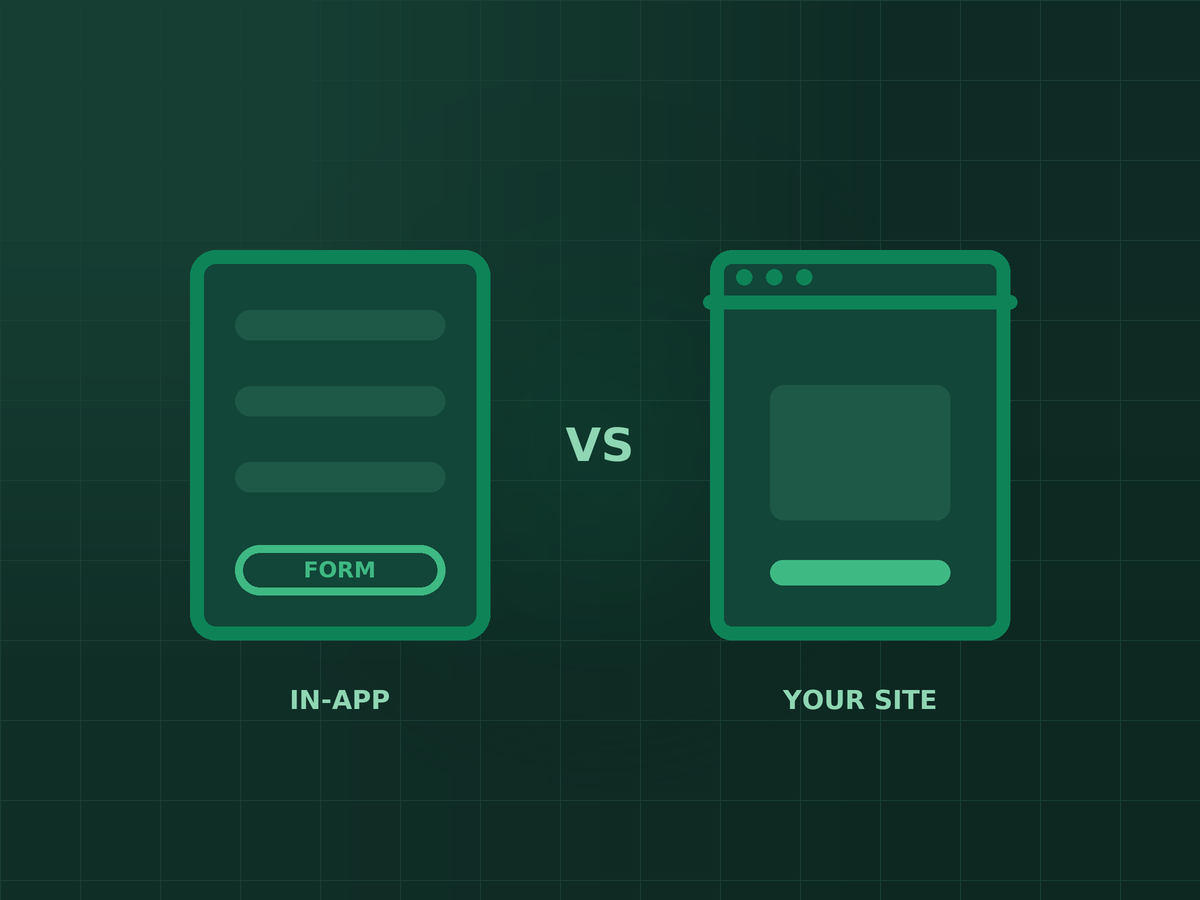
Short answer: Lead ads collect enquiries inside Facebook and Instagram with a pre-filled form, which usually means more leads at a lower cost per lead; website conversion campaigns send people to your own page, which usually means fewer but more deliberate leads. Neither is automatically better — test both with the same offer and judge them by cost per qualified lead, not cost per lead.
Many advertisers pick one of these two setups by habit, then blame the platform when the leads do not buy. The setups behave differently, and knowing how helps you choose — and read the results correctly.
What each one actually is
Lead ads (Meta's Instant Forms) open a form inside the app. Name, email and phone number are usually pre-filled from the person's profile, so submitting takes a couple of taps and they never leave Facebook or Instagram.
Website conversion campaigns send the click to your own landing page or contact form, and optimise for a conversion you track on that site — a submitted form, a booking, a purchase. For that to work, your tracking has to be set up properly; see Meta Pixel and Conversions API explained.
The trade-offs
- Volume and cost per lead. Lead ads tend to produce more leads at a lower cost per lead, because the form is so easy to complete.
- Lead quality. That same ease is why lead ads can bring more low-intent leads — accidental taps, people who were only curious, or outdated pre-filled phone numbers.
- Control of the experience. On your own site you control the message, the page speed, the questions you ask and what happens after submitting. In a lead form you are limited to what the form allows.
- Setup effort. Lead ads are quicker to start and do not depend on a website. Website campaigns depend on a good landing page and working tracking.
- Data capture. Lead ads put the lead straight into Meta's system, so you need a reliable way to get that data to the person who will follow up — quickly.
Making lead ads better
If you use lead ads, add friction on purpose. Meta lets you choose a form type that favours higher intent over higher volume, and you can add a qualifying question or two and a review step before submission. Fewer people will complete it, and the ones who do are more likely to be real prospects.
Speed matters more than anything else with these leads. Someone who filled a form in two taps has forgotten about it soon after, so a call or message within minutes is very different from one the next day.
When each one makes sense
- Lead ads fit simple, low-commitment offers — an enquiry, a quote request, a free consultation — especially when you do not yet have a strong landing page and you can follow up fast.
- Website conversion campaigns fit higher-consideration offers where the customer needs to read, compare and decide, and when you want to learn from tracked on-site behaviour.
- Both is often the honest answer: run one of each against the same offer and let the results decide.
How to run a fair test
Use the same offer, a similar audience and the same budget split. Run it long enough that a handful of unusual leads does not decide the outcome. Then compare the number that actually matters: cost per qualified lead, or cost per sale if you can track it. A campaign with a lower cost per lead can still lose once you count the leads that never answer.
If your results change suddenly, check the basics first — see why Facebook ads stop working and what to check first — and review your audience choices using the ad targeting guide.
Key takeaways
- Lead ads use an in-app form, so they are easy to complete; website campaigns send people to your own page and tracking.
- Lead ads usually bring more leads at a lower cost per lead, but lead quality tends to vary more.
- Add qualifying questions or a review step to lead ads, and follow up within minutes.
- Judge both by cost per qualified lead or per sale, not by cost per lead alone.
Frequently asked questions
Which has the lower cost per lead?
Lead ads usually do, because the form is easier to complete. But a lower cost per lead does not mean a lower cost per customer, so always compare the cost of qualified leads or sales.
Why aren't my Facebook leads answering their phones?
Common reasons are slow follow-up, accidental or low-intent submissions, and pre-filled details that are out of date. Contacting leads quickly and adding a qualifying question to the form helps.
Do lead ads need a website or a pixel?
Lead ads can collect enquiries without a website, because the form lives inside the app. Website conversion campaigns do need a landing page and working tracking, which is where the pixel and Conversions API come in.
Can I run both at the same time?
Yes, and it is often the most reliable way to find out which works for your business. Use the same offer and compare them on cost per qualified lead.
How long should I test before deciding?
Long enough that a few unusual leads cannot change the answer. There is no single number that fits every account, so judge by whether the result is stable rather than by a fixed day count.

SEO specialist and digital marketer from the Philippines. I handle SEO for the country’s biggest media and publishing brands — Vogue Philippines, MEGA, Billboard Philippines, Rolling Stone Philippines — alongside clinics, e-commerce stores, and startups. Every article here comes from real client campaigns.
Not sure which setup suits your offer?
I will look at your offer, your follow-up process and your tracking, then recommend a campaign structure and a fair test plan.